Chemical Space Exploration and Molecular Design of Organic Donor–Acceptor TADF Emitters
Journal of Materials Chemistry C · DOI: 10.1039/D6TC00707D
Computational chemistry · automated exploration · scientific software
We build methods and software to explore molecular structures, reactions and chemical space at Digital University Kerala.
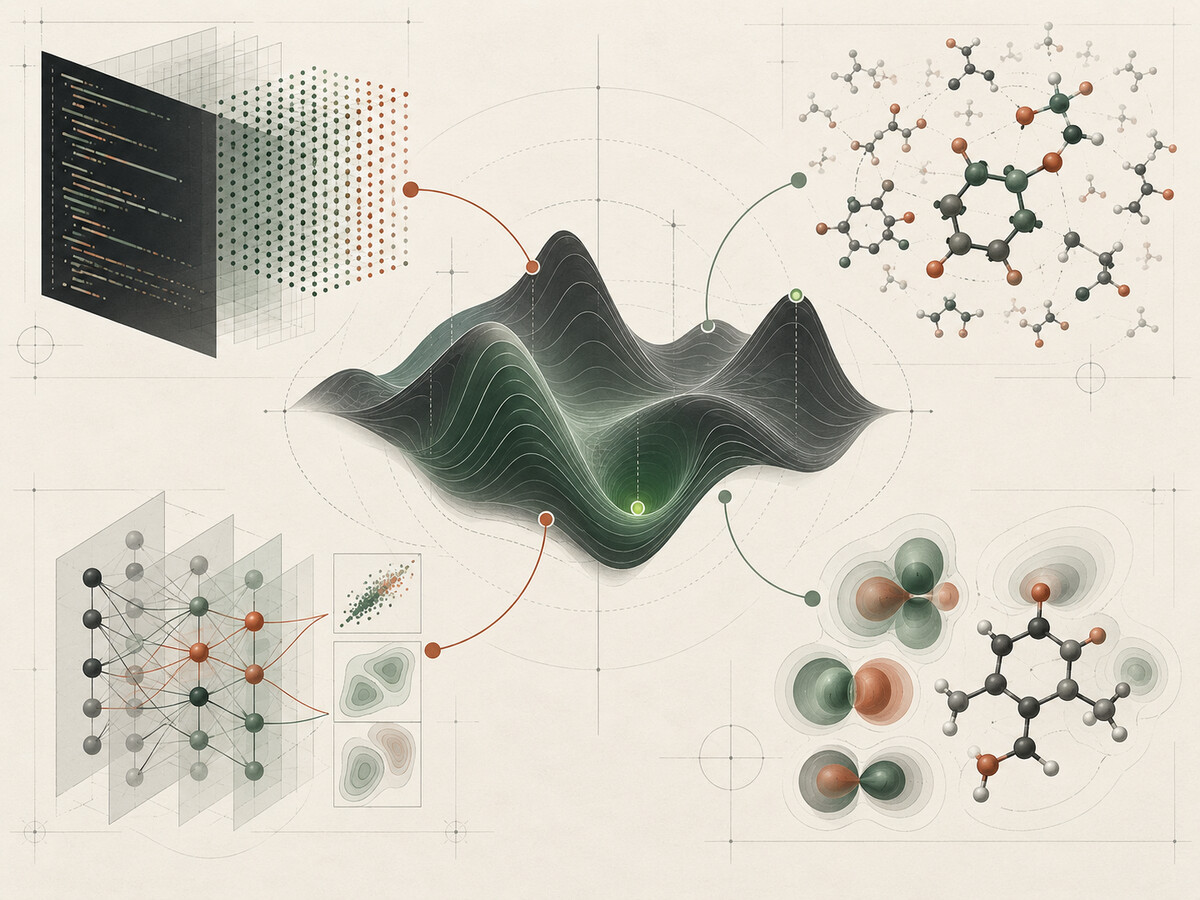
Our research combines quantum chemistry, automated search and scientific machine learning to discover and understand molecules. The programme developed across Digital University Kerala and IIT Kharagpur, with chemical interpretation and rigorous validation at its core.
01 · Research programme
Automated exploration asks how chemical possibilities can be generated and searched systematically. Scientific machine learning helps make those searches faster, more selective and more interpretable when the scale of the problem requires it.
Methods and software for generating molecular structures, navigating reactions and exploring chemical space beyond hand-selected candidates. Research approach PyAR
Chemically grounded models that accelerate calculations, guide search and reveal interpretable structure–property relationships, with explicit attention to validation, uncertainty and domain limits. Research approach
Reaction discovery, structural exploration and functional molecular design provide the main application areas in which the two directions meet.
Explore the full research programme02 · Scientific evidence
Recent developments and representative methodological foundations.
Journal of Materials Chemistry C · DOI: 10.1039/D6TC00707D
Sustainable Energy & Fuels 10, 3240–3251 · DOI: 10.1039/D6SE00364H
Journal of Computational Chemistry 46, e70236
Frontiers in Chemistry 7, 644
Research theme: molecular aggregates, nanoclusters and nanoalloys
Chemistry – A European Journal 24, 4885–4894
Computational and Theoretical Chemistry 1111, 69–81
03 · Software and data
Flagship programme
PyAR is our flagship research-software programme for automated exploration of molecular structures, reactions, aggregates and atomic clusters. Current development focuses on making these workflows more robust, extensible and usable beyond our own group.
Explore the PyAR research programmeA searchable dataset and chemical-space explorer for hydrocarbons.
Explore HydroMolAn implementation of Gillespie's stochastic simulation algorithm.
View the repository04 · People and continuity
Current researchers are shown here; the complete alumni record is maintained separately.
AnoopLab alumni include former PhD and MSc researchers working across academia, research institutes, and related scientific roles.
Complete alumni record and group photographs05 · Contact
For research enquiries and potential collaborations, contact A. Anoop.
School of Digital Sciences
Digital University Kerala
Technopark Phase IV, Pallipuram
Thiruvananthapuram, Kerala 695317